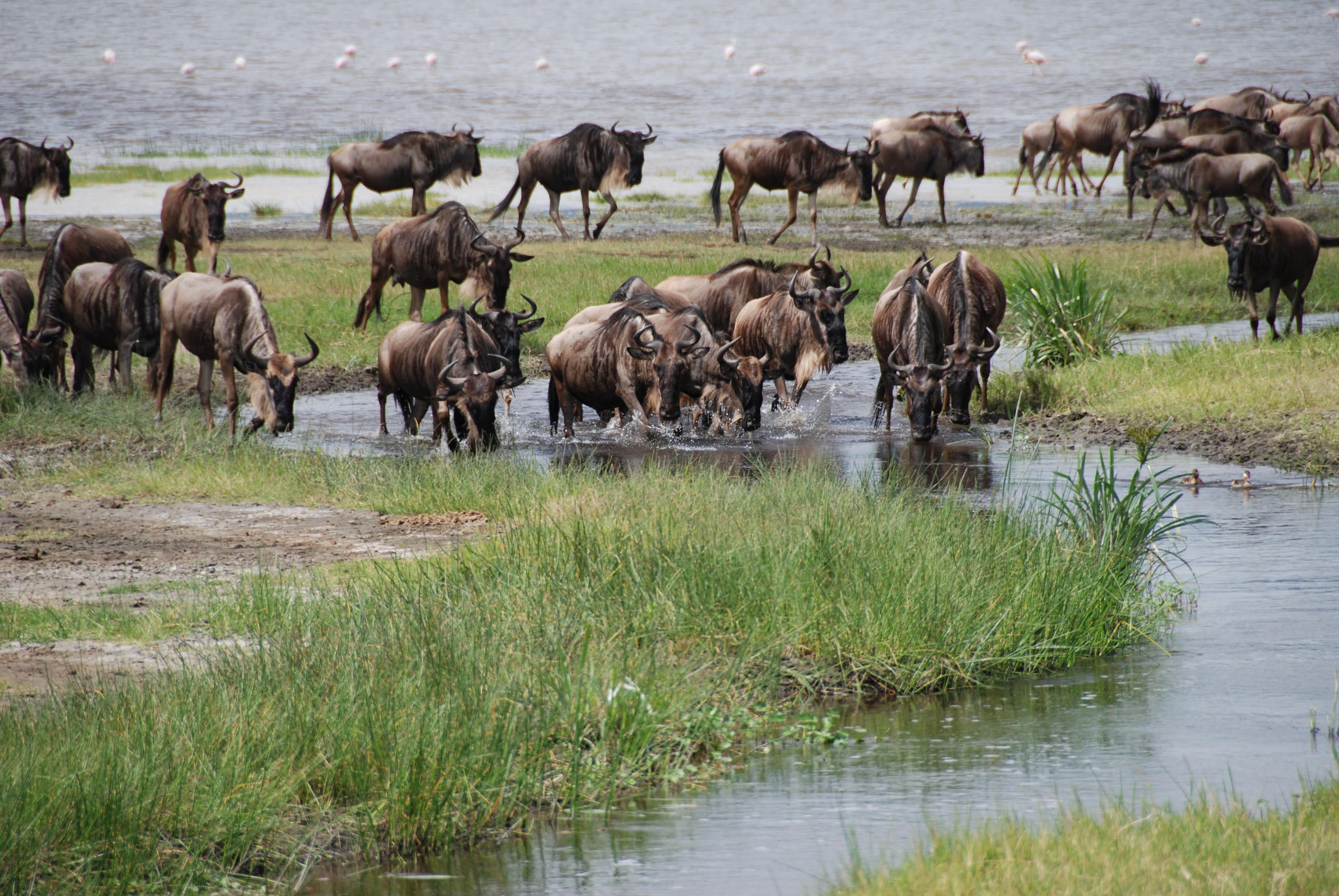
What a Wildebeest Thinks During the Mara River Crossing
I have been walking for three months.
My hooves are worn. My legs ache in ways I cannot describe. The dust of the Serengeti has settled so deep into my coat that I have forgotten what it feels like to be clean. Around me, in every direction, as far as any eye can see, are others like me — a moving, breathing, thundering mass of bodies, all pulled by the same invisible force, all heading in the same direction.
North.
Always north.
I do not know why. I never do. No wildebeest does. There is no map, no leader, no plan. There is only the pull — ancient, primal, irresistible — like a thread stitched into the very fabric of who I am, tugging me forward across the endless plains of East Africa toward something I cannot name but cannot resist.
And then, one morning, I smell it.
Water.
The Gathering
The Mara River does not announce itself gently. It does not trickle or whisper. It roars — dark and fast and alive with things that want to eat me. I have crossed it before. I think. The memory is not clear. What is clear, with a certainty that reverberates through every nerve in my body, is that the river is dangerous.
I stop at the bank.
Around me, thousands do the same. We push and surge and press against each other in a chaos of bodies and breath and noise. The smell of the river fills everything — mud, water, something else. Something ancient and cold and patient.
Below us, barely visible beneath the surface, shapes move.
We all see them. We all know what they are.
And yet we cannot turn back. The pull is too strong. The grass on the other side is greener — literally, visibly, achingly greener — and three months of walking have made that green the only thing that matters.
So we wait. And we surge. And we wait again.
This is the part that the tourists in their safari vehicles do not understand. They watch us from the riverbank, cameras raised, breath held, waiting for the moment we jump. What they do not see is the negotiation happening inside every one of us — the ancient argument between fear and hunger, between survival and instinct, between the crocodile I can see and the starvation I cannot survive.
The Decision Nobody Makes
No single wildebeest decides to jump.
That is the strange, terrifying truth of it. The crossing does not begin with courage or leadership or a moment of individual bravery. It begins with pressure — the weight of thousands of bodies behind me, the surge of the herd, the slow inevitable momentum of a million animals all wanting the same thing at the same time.
And then — without deciding, without choosing, without any conscious act of will — I am in the air.
The bank drops away beneath me.
The river rises up.
And for one single, suspended, breathless moment — I am flying.
The Crossing
The water hits like a wall.
Cold. Dark. Fast. It grabs at my legs and pulls at my body and fills my ears with a roaring that drowns out everything — the bellowing of the herd, the shouts of the distant tourists, the sound of my own heartbeat. I kick. I fight. I keep my head above the surface and fix my eyes on the far bank and I do the only thing any wildebeest has ever done in this moment.
I swim.
Around me, the river is alive with bodies — hooves churning, heads straining, eyes wide and white with terror. The surface boils with the effort of a thousand animals all fighting the same current, all reaching for the same distant bank, all running the same terrible calculation in their heads.
And then I feel it.
A pressure around my leg. A pull from below. Something ancient and enormous and utterly indifferent to whether I live or die.
I kick harder.
I do not look down.
This is not bravery. Bravery requires a choice, and I have no choice. There is only forward — only the green bank ahead, only the grass I have been walking toward for three months, only the thread pulling me north with a force stronger than fear.
My hooves touch rock.
I scramble.
I climb.
The Other Side
And then I am out.
Water pours from my coat. My legs tremble with an exhaustion so deep it feels like it lives in my bones. Around me, others emerge from the river — shaking, gasping, eyes still wide — and for a moment we stand together on the far bank in something that might, if wildebeest were capable of such things, be called relief.
Behind us, the river continues its work. Not everyone made it. This is the part I do not think about. This is the part that the tourists will film and some will find difficult to watch — the crocodiles, the current, the ones who were simply unlucky or simply too young or simply too old. Nature does not apologise for this. It never has. The river crossing is not a triumph for all. It is a triumph for enough.
And enough is all that has ever been required.
I lower my head.
I eat the green grass of the Maasai Mara.
It tastes exactly like three months of walking.
What the River Crossing Really Is
Every year, between July and October, over one and a half million wildebeest and hundreds of thousands of zebra make the Great Migration — the largest overland movement of animals on the planet. Driven by rainfall patterns and the growth of fresh grass, the herds move in a giant clockwise circuit between Tanzania's Serengeti and Kenya's Maasai Mara, crossing the crocodile-filled Mara River multiple times in one of the most dramatic wildlife spectacles the natural world has ever produced.
No other event in nature concentrates so much raw life, raw death, raw instinct, and raw beauty into a single moment.
Witnessing a river crossing is not like watching a nature documentary. It is louder, messier, more emotional, and more overwhelming than any screen can convey. The ground trembles. The air fills with dust and noise. And somewhere in the chaos, if you are still and quiet enough, you feel something shift inside you — a recognition of something ancient and true about the world that is very difficult to put into words afterward.
Our guests who have witnessed a crossing tell us it is the single most unforgettable moment of their lives.
We believe them.
Experience the Great Migration with Sublime Travel
At Sublime Travel, we design Kenya safari itineraries that put you in the right place at the right time — positioned at the Mara River during peak crossing season, in a vehicle with an experienced guide who knows the river's rhythms and the herd's movements.
We do not guarantee crossings. Nobody can. But we know the Maasai Mara intimately, and we know how to give you the best possible chance of witnessing one of the greatest shows on earth.
The Migration season runs from July to October. Spaces fill fast.
Contact us at sublimesafaris.com to start planning your Kenya safari today.
call +254110090711
www.sublimesafaris.com
Share This Story
