The Dark Side of Poaching: Kenya's Wildlife Crisis and the Fight That Saved the Rhino
There is a photograph taken at Ol Pejeta Conservancy in Kenya in 2018 that most people who have seen it say they cannot forget.
It shows Sudan — an old male rhino, grey and heavy-limbed, lying on his side in the red Laikipia soil. Around him, kneeling, are the rangers who had guarded him around the clock for years. Some of them are weeping.
Sudan was the last male northern white rhino on earth. When he died on March 19, 2018, a subspecies effectively ended. Not from natural causes. Not from disease. From the accumulated consequence of decades of killing for a horn.
This is the story of what poaching really looks like — not the sanitised version, not the statistic — and how Kenya, against considerable odds, began to fight its way back.
A Number Worth Understanding: 381
In 1970, Kenya was home to an estimated 20,000 black rhinos. They moved across the savannah in numbers large enough that early colonial-era naturalists described them as one of the defining features of the East African landscape.
By 1987, there were 381 left.
Not 381 in one park. 381 in the entire country. An animal that had existed on this continent for millions of years had been reduced, in less than twenty years, to a population you could seat in a modest lecture hall.
No earthquake caused this. No plague. No asteroid. Organised, industrial-scale killing — driven by international demand and enabled by corruption, poverty, and the catastrophic failure of enforcement — did it quietly, efficiently, and almost completely.
Understanding that number is the beginning of understanding why conservation in Kenya is not an abstract cause. It is an emergency response that started late and is still ongoing.
How the Poaching Machine Actually Worked
The popular image of a poacher — a lone figure moving through the bush at night — is not wrong exactly, but it is dangerously incomplete.
At the height of the rhino crisis in East Africa, poaching was a supply chain. Horn was harvested in the field, moved across borders through networks that overlapped with arms trafficking and narcotics routes, laundered through intermediaries, and delivered to end markets in Yemen — where it was carved into ornamental dagger handles as status symbols — and across parts of Asia, where it was sold as a fever remedy and aphrodisiac despite containing no pharmacologically active compounds beyond keratin. The same material your fingernails are made of.
The economics made it almost impossible to fight at the source. A single black rhino horn in the 1980s could fetch the equivalent of several years' wages for a rural worker. Rangers were paid poorly, equipped inadequately, and routinely outgunned. Corrupt officials at every level of government created corridors through which horn moved with impunity.
The animal in the middle of this supply chain had no more significance to the criminal networks profiting from it than timber has to illegal loggers. It was a raw material. It was being extracted until there was none left.
The Bonfire That Changed the Conversation
On July 18, 1989, Kenyan President Daniel arap Moi walked into Nairobi National Park and set fire to twelve tonnes of confiscated ivory in front of an international press corps.
The images went around the world. The message was deliberate and unambiguous: Kenya was declaring that wildlife had value beyond commerce. That it could not and would not be treated as a liquidatable asset.
The bonfire was theatre — but it was effective theatre. Later that year, CITES voted to impose a global ban on ivory trade. The ban was imperfect, enforcement was patchy, and poaching did not stop. But something had shifted in the international conversation, and with it, gradually, in Kenya's own institutional response.
What followed over the next three decades was not a clean narrative of progress. It was contested, expensive, and paid for in lives.
The Cost Nobody Talks About Enough
Between 2009 and 2016, more than one thousand rangers were killed across Africa in the line of duty.
One thousand. In seven years.
These were men and women, many of them from the communities surrounding the parks they protected, earning wages that bore no relationship to the value of the animals they were guarding. They died in ambushes, in crossfire, in encounters with poaching units that were sometimes better armed than the anti-poaching teams sent to stop them.
Their deaths generated a fraction of the international coverage that a single high-profile rhino killing could produce. The animals, in the global media ecosystem, were often more visible than the people dying to protect them.
This is not a comfortable thing to acknowledge. It sits at the centre of what conservation in Africa actually costs, and who pays it.
Ol Pejeta and the Model That Worked
The Ol Pejeta Conservancy in Laikipia — 90,000 acres of open savannah at the foot of Mount Kenya — became, over the course of the 1990s and 2000s, one of the proving grounds for a different approach to rhino conservation.
The core insight was economic rather than ideological: wildlife needed to generate revenue for the communities living alongside it, or those communities had no rational incentive to protect it. Fortress conservation — the model where parks are locked off from surrounding populations and patrolled by force — had been tried. It produced the 1980s.
Ol Pejeta built a model where tourism revenue funded ranger salaries, community schools, health clinics, and water projects in adjacent villages. When a family in Laikipia could trace their child's education to the presence of live rhinos on the conservancy, the calculus changed. Live animals became worth protecting not as an abstraction but as an economic reality.
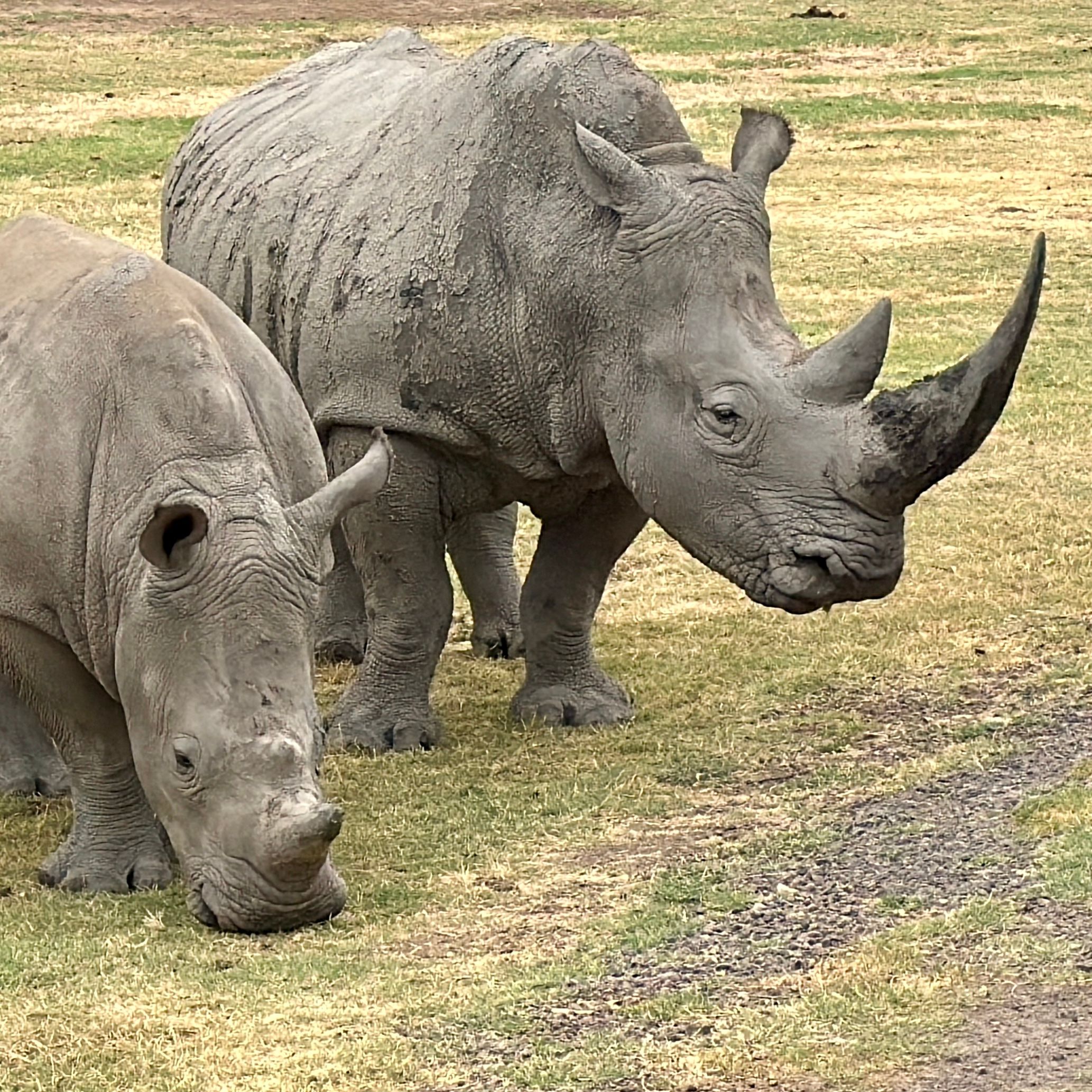
It worked. Ol Pejeta today holds more black rhinos than any other conservancy in East Africa. It was also the home of Sudan, Najin, and Fatu — the last three northern white rhinos on earth — kept under armed guard in their final years, their story a monument to what happens when intervention comes too late.
Najin and Fatu are still there. Scientists are attempting IVF procedures using stored genetic material in a last effort to prevent total extinction of the subspecies. It may work. It may not. But the attempt itself says something about what Kenya has decided these animals are worth.
Where the Numbers Stand Today
Kenya's black rhino population has recovered from that catastrophic low of 381 to over 900 individuals — a more than 130% increase achieved over three decades of sustained effort.
It is one of the most significant large mammal conservation recoveries on the African continent. It happened through a combination of strengthened anti-poaching enforcement, community-based conservation economics, international legal pressure on demand markets, and the sustained commitment of conservancies, NGOs, and the Kenyan Wildlife Service.
It is not a finished story. Poaching pressure is not constant — it fluctuates with the price of horn on black markets, with political stability, with economic conditions that push desperate people toward desperate choices. In years when enforcement weakens, the numbers feel it.
But the trajectory has reversed. That reversal was not inevitable. It was chosen, fought for, and paid for. Kenya proved it was possible.
Why Your Safari Is Part of This
Tour operators do not always say this plainly, so we will.
Tourism is conservation infrastructure. Not metaphorically — structurally, financially, operationally.
Every park entry fee funds Kenya Wildlife Service operations. Every bed night at a conservancy lodge funds ranger salaries and community programmes. Every guide employed from a village adjacent to a wildlife area is a household with a direct economic stake in the continued presence of wild animals.
When that economic link breaks — when tourism collapses, as it did briefly during the COVID-19 pandemic — conservancies immediately face funding crises. Rangers go unpaid. Poaching pressure increases. The connection between a traveller choosing a destination and an anti-poaching unit having the resources to operate is not abstract. It is direct.
When you book a safari with Sublime Travel to Ol Pejeta, to the Maasai Mara, to Amboseli — you are not only experiencing one of the most extraordinary wildlife environments on earth. You are participating, in the most direct way available to a visitor, in the ongoing argument that these animals are worth more alive than dead.
That argument still needs making.
Kenya is winning it. But only just, and only together.
Plan Your Conservation Safari with Sublime Travel
We build Kenya itineraries that take you to the places where this story is still being written — Ol Pejeta, the Maasai Mara, Laikipia, Amboseli — with guides who know the land and the history, and lodges whose operations are embedded in the communities around them.
This is East Africa, done with intention.
Sublime Travel — East Africa, done right.
[Contact us to start planning your Kenya conservation safari →]
call +254110090711
Share This Story
